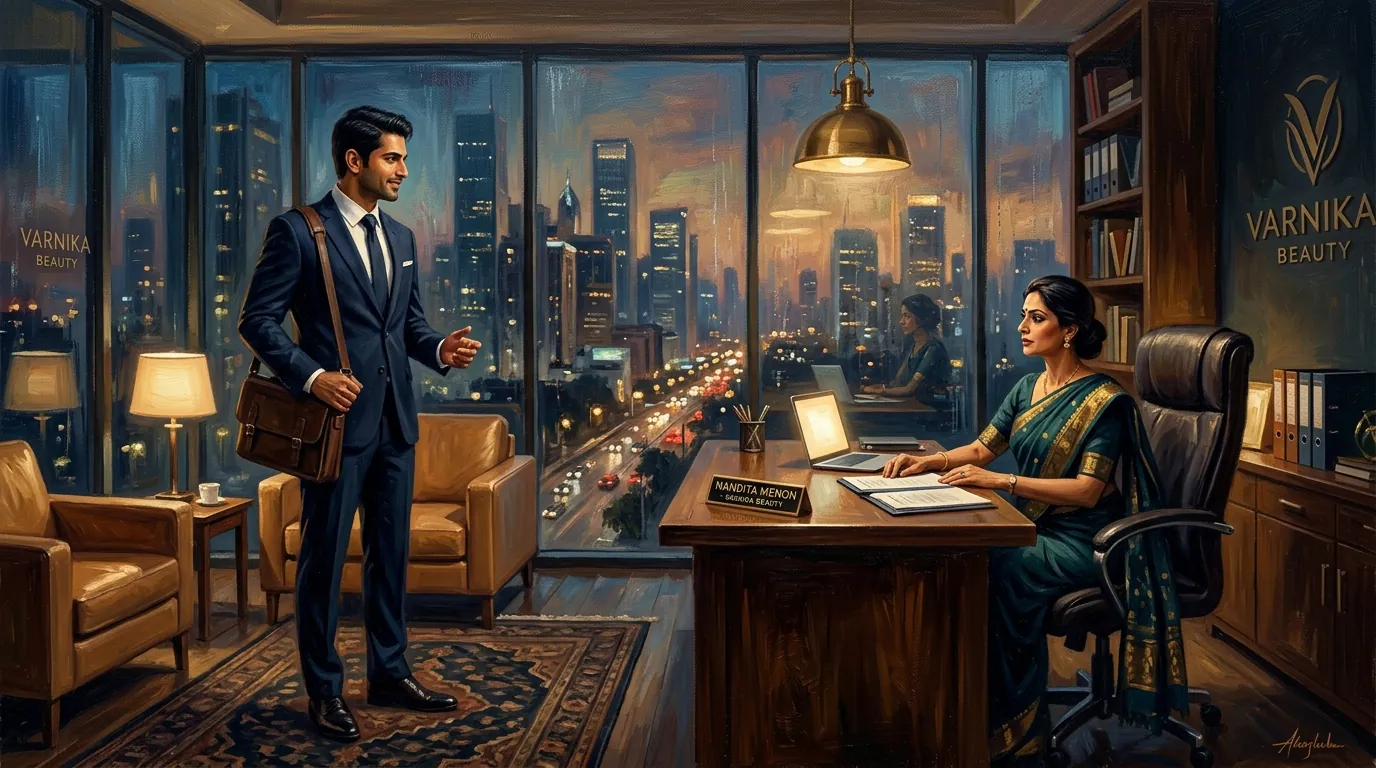
Vasudha’s secretary. Not Vasudha herself, but close enough to make the request feel deliberate.
“Yes, of course,” he says.
“Ten minutes.”
The line goes dead.
Aalekh looks once at the screen, then at the glass wall across the corridor, where the city has begun to darken into a field of lights. A faint smile touches his mouth and leaves just as quickly. He gathers the printed sheets, slips the laptop into his bag, and walks.
The founder’s suite sits on the top level of HQ, separated from the rest of the office by a discreet access door and a corridor lined with framed campaign photographs from Varnika’s history. Past launches. Awards. Magazine covers. The brand’s evolution displayed like a lineage. Women in high heels and sharper decisions. Lipsticks, serums, compacts, all turned into symbols of confidence and control.
He has only been up here twice before, both times in a group, both times while Vasudha was already moving on to another meeting. Tonight the corridor is empty.
The secretary opens the door with a brief nod and gestures him in.
Inside, the suite is quieter than the rest of the building. The lighting is warmer. The furniture is less corporate, more curated—camel-toned leather, low brass lamps, a long sideboard with crystal tumblers and a tray of untouched biscuits. Through the far glass wall, Mumbai is a dark, glittering spread.
Vasudha stands near the window, phone in hand, as if she has just finished a call she did not enjoy. When she turns, the expression on her face is neutral, but there is something in her eyes that is not.
“Leave the deck,” she says.
He does, placing it carefully on the table in front of her.
She does not pick it up immediately. Instead, she studies him the way she might study a new market entry—quietly, without waste. Her gaze passes over his face, the collar of his shirt, the watch on his wrist, the faint shadow at his jawline where the evening shave has already begun to lose its perfection.
“You stayed late,” she observes.
“There was still work.”
“Mm.” She walks to the sideboard, pours water into a glass, then changes her mind and instead reaches for the tea setup. “Do you drink tea?”
Aalekh blinks once. “Yes.”
The corner of her mouth moves, not quite a smile. “Good. So do I.”
She begins preparing it herself.
That, more than anything, unsettles him.
Women like Vasudha do not pour tea for juniors. They summon, they delegate, they watch. They do not perform domestic ease unless they intend it as a message. And messages from women like her are never accidental.
He remains standing where he is, posture relaxed enough to seem natural, alert enough to catch every shift in her movement. She measures the leaves. Pours water. Lets it steep. No rush. No hurry. The patience of someone who has spent decades making other people wait for her.
When she sets one cup in front of him, their fingers do not touch. They come close enough to make the distance feel intentional.
“Sit,” she says.
He does.
She takes the chair opposite him, crossing one leg over the other with slow, exact grace. The room feels suddenly smaller, though nothing has moved.
For a moment, neither speaks. The city hums behind the glass. Somewhere below, a lift dings. Somewhere farther away, a phone rings and is ignored.
Then Vasudha says, “Nandita respects your work.”
Aalekh lowers his eyes to the tea. “I’m glad.”
“Priya trusts your instincts more than she should admit.”
He lifts his gaze. “I’m flattered.”
“And Shalini,” she says, watching him carefully, “finds you useful.”
He does not smile. “Useful is not a bad thing.”
“No,” Vasudha says. “It is not.”
She sips her tea, and the silence after that sip is almost intimate.
Aalekh has spent enough time around powerful women to know that the most dangerous moment is not when they flirt. It is when they stop pretending the conversation is only about work.
Vasudha sets down the cup. “Tell me something, Aalekh.”
“Yes?”
“Do you know why I called you here?”
There are many possible answers. He chooses the one that gives her room to reveal herself.
“To discuss the launch.”
“That too.” Her eyes remain on his face. “But not only that.”
He waits.
Outside, traffic threads light through the city like a moving necklace.
Vasudha folds her hands. “You have a talent for making people feel seen.”
The sentence lands with subtle force. He keeps his expression composed.
“I try to understand the brief,” he says.
“Don’t reduce yourself.” Her voice is cool, but not unkind. “You know what you do.”
He lets a small silence form. Then: “And what do I do, ma’am?”
That finally earns him a look—sharp, approving, almost amused.
“You make women forget they are supposed to be guarded.”
The words sit between them, elegant and dangerous.
Aalekh does not answer immediately. He lets the moment breathe. A lesser man would deny, deflect, overplay innocence. He knows better than that. Denial looks cheap. Calm is more seductive.
“I think,” he says at last, “that women at Varnika are not easy to impress. So when they do trust someone, it usually means that person has earned it.”
Vasudha’s gaze narrows slightly, as if she is measuring the sophistication of the dodge.
“And have you earned it?” she asks.
The question is too direct to be casual.
Aalekh leans back a fraction, one hand resting over the arm of the chair. “I hope so.”
She studies him for a long beat, then looks away toward the window. From this height, the city appears like a field of unspoken things.
“When I built this company,” she says, and her voice changes—not softer, exactly, but more private, as if she has decided he deserves a smaller room inside her tone—“people thought I was driven. Or difficult. Or lonely.” A faint, dry smile touches her mouth. “Sometimes all three in the same week.”
Aalekh says nothing.
“I was called ambitious when the word was still meant to sound like an accusation,” she continues. “And cold, when I was simply tired of explaining myself.”
The tea in his cup has gone slightly cooler. He has not touched it. He is listening too carefully now, because the room has shifted from business to confession, and confession from a woman like Vasudha is rarer than a board-approved miracle.
She turns back to him.
“Men,” she says, “can be lonely in ways that are forgiven. Women are lonely in ways that become public property.”
He feels the weight of that sentence in his chest, though he does not show it.
For a moment, the founder is not the founder. She is simply a woman at the top of a building no one dares to question, speaking to a younger man who has the audacity to look at her without fear.
Aalekh’s voice, when it comes, is softer. “You don’t seem like someone who needs forgiveness.”
Vasudha looks at him for a long time. The room is quiet enough to hear the faint hum of the air conditioner.
“No,” she says finally. “I need control.”