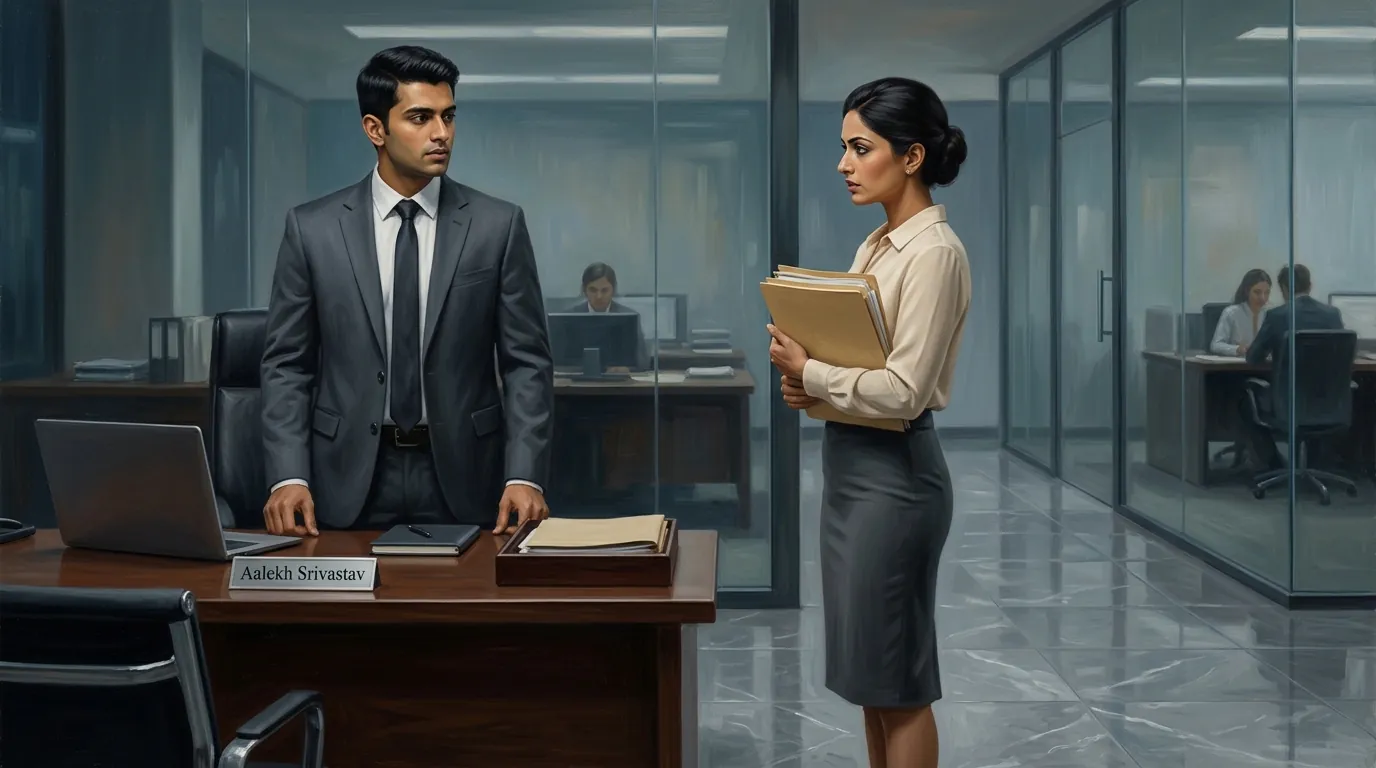
The owner’s suite is one floor above the board room, behind a frosted-glass door that never stays open for long. It is not lavish in the vulgar sense. There is no overdecorated wealth, no shouting of status. The space is elegant to the point of intimidation—dark wood, ivory upholstery, a single vase of white lilies, and a wall of framed photographs that trace Varnika’s growth from a vanity-table dream to a national empire. In each image, Vasudha stands straighter than the people around her. In each image, she looks like she already knew the ending.
She sits behind her desk with a cup of tea untouched beside her, the kind of woman who does not drink before she decides what the room is for.
Aalekh stops a few feet from the desk.
“Come in,” she says.
He does. Closer now, he can smell the faint, expensive restraint of her perfume—powdery, dry, almost old-money in its elegance. Vasudha Singhania is in her fifties, but she wears age like authority rather than loss. Her silk sari is muted gold, her jewellery discreet, her expression calm enough to frighten a lesser man into honesty.
She gestures to the chair opposite her.
He sits only when invited, posture relaxed, elbows close, the picture of a young executive who knows how to respect power without appearing afraid of it.
Vasudha looks at him for a long moment. Not like a boss. Not even like a woman assessing an employee. More like a founder deciding whether a thing she once acquired for utility has become too beautiful to keep.
“You have become expensive,” she says at last.
Aalekh’s mouth curves, barely. “I wasn’t aware I’d increased my billing rate.”
Her gaze remains level. “Do not perform for me.”
He stills.
There are many women at Varnika who like being charmed. Vasudha is not one of them. She likes clarity, usefulness, control. If she admires a performance, it is only because she has already seen the mechanism behind it.
“I’m not performing,” he says.
“No?” She leans back slightly. “Then explain why everyone in this building now has an opinion about you.”
“Because they’re bored.”
“Because you have made them curious.”
Aalekh lets the quiet sharpen between them. He does not answer immediately, because the best answer is not always the first one.
Vasudha takes a slow sip of tea at last, as though rewarding him for not speaking too early.
“You are useful,” she says. “You understand the market. You present well. Clients respond to you. The younger team respects you. Even the older women—” She pauses, not smiling. “—are distracted by you.”
He says nothing.
“Which would be fine,” she continues, “if distraction did not begin to look like preference.”
There it is. The center of the matter, stripped of decorum.
Aalekh rests one hand lightly on the arm of the chair. “Ma’am, I have done nothing unprofessional.”
Vasudha’s eyes move over him with the cool detachment of someone who has seen every version of male innocence and no longer confuses it with virtue.
“You have not had to do very much,” she says. “That is the problem.”
He meets her gaze directly now. It is one of the few things he can do that makes women like her pause. He knows he is young enough to be underestimated, polished enough to be tolerated, and attractive enough to be forgiven for things that would destroy another man. He uses all three facts with care.
“If there is an issue,” he says softly, “I would prefer to address it before it affects the work.”
Vasudha studies him as if weighing whether that sentence is sincere or simply well-crafted.
Then she says, “The board is asking whether you are a talent or a liability.”
Aalekh feels the room tighten.
Not because it surprises him. Because it confirms the shape of the danger. Board-level language is never casual. Talent can be managed. Liability can be removed.
He lets a beat pass, then gives the smallest shrug, almost wry. “And what do you think?”
For the first time, Vasudha’s expression changes. Not enough to be called emotion. Just a slight narrowing, as if he has approached the edge of something she has not offered.
“I think,” she says, “that you are too clever to be reckless and too young to know how quickly cleverness becomes arrogance.”
He smiles at that, though it does not quite reach his eyes. “Is that your way of warning me?”
“It is my way of deciding whether to keep you.”
The words are quiet. Clean. Brutal.
Aalekh feels his pulse move once, hard.
He should be intimidated. He is, in one sense. But beneath it is something else—an old, dark thrill that women like Vasudha create in him. To be measured by someone who can erase him. To be kept only if he remains valuable. It is not comfort. It is power. And power, for him, is often the same as desire.
Vasudha reaches for a folder at the edge of her desk and slides it toward him.
Inside are the board talking points. The campaign delay. The budget overrun. The leak concerns. And one final page with notes in Vasudha’s hand—brief, surgical, devastatingly precise.
“Read that before the meeting,” she says, repeating Nandita’s phrase in a different key. “If anyone asks about your role in the delay, you explain the vendor issue. If they ask about internal communication, you say only what you can defend. Nothing more.”
He looks up. “You’ve already decided I stay.”
“I have decided,” she says, “that I dislike waste.”
It is not affection. It is not quite mercy. But it is protection of a kind. In Varnika, that can be more intimate than either.
Aalekh inclines his head. “Then I won’t waste your investment.”
Vasudha’s gaze lingers on him a second longer than required.
“Be careful,” she says quietly. “Women are beginning to talk to one another.”
Aalekh holds her eyes. “About me?”
“About what they think they want from you.”
He does not smile this time. He only listens.
Because the line between desire and damage is becoming thin enough to cut.
When he leaves her office, he notices Priya waiting near the corridor window, one hand around a paper cup of coffee, the other resting on her hip as she stares out at the city. The afternoon light catches her bangles and the edge of her saree blouse, and for a second she looks less like a manager and more like a woman trying not to be seen waiting for someone.
Which, naturally, makes her more visible.
She turns before he reaches her.
“Come with me,” she says.
Not a request.
He follows.
Priya’s office is warmer than the others, with softer lighting and a faint trace of vanilla lotion in the air. The space feels lived-in, unlike Vasudha’s immaculate power or Nandita’s disciplined order. There are family photographs on one side of the desk, though turned at a slight angle, as if even sentiment must be managed here. Her chair is pushed back. Her laptop is open. A half-written mail waits on the screen.
She shuts the door behind them.