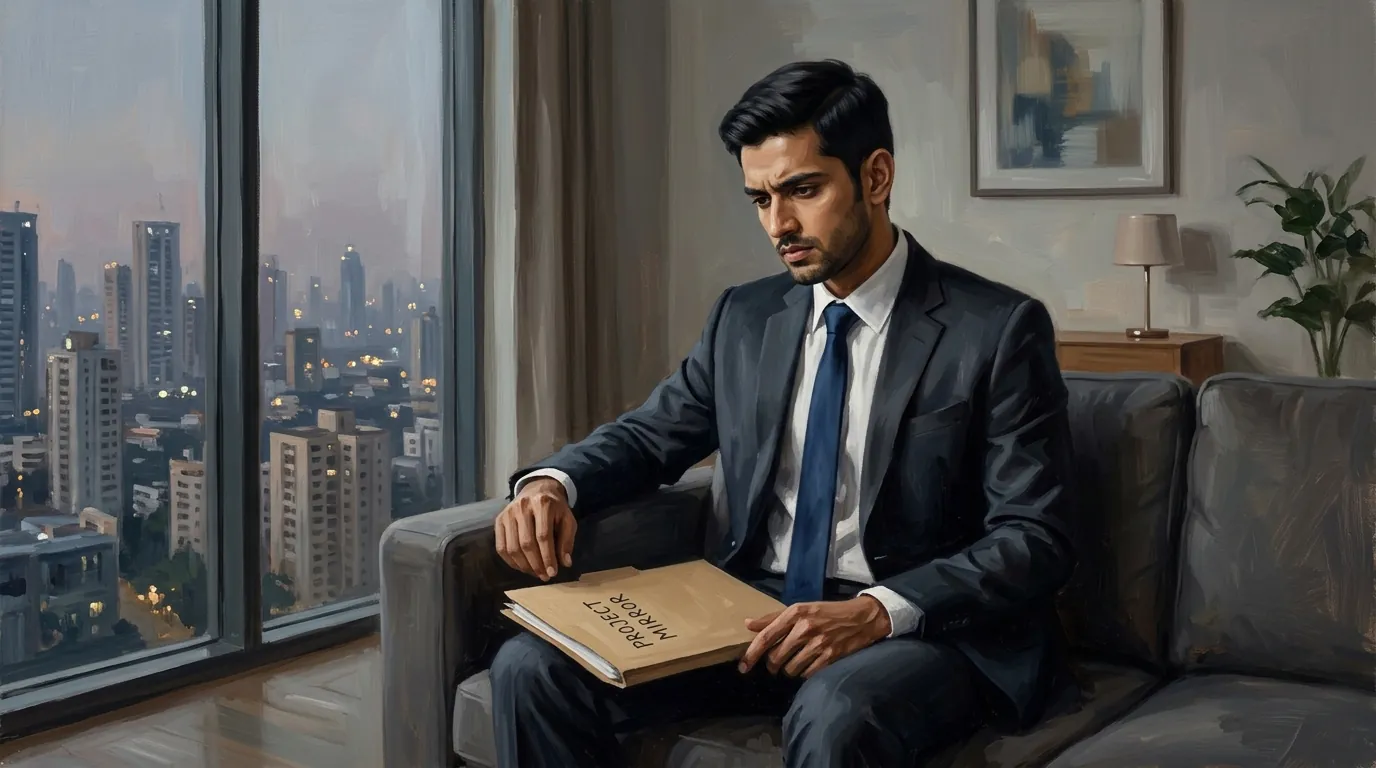
The note is signed, not by a junior analyst, not by HR, but by Shalini.
He sits very still.
For a moment the apartment seems too neat, too airless. Outside, someone laughs in the corridor. A scooter horn blares below. Life continues in its ugly ordinary way.
He reads the line again.
Keep him close.
His first instinct is to laugh. His second is to feel offended. His third is worse because it is more honest: a thin, hard pulse of respect.
Not affection. Not gratitude. Respect.
It does not mean everything was fake. That is the mistake a man makes when he has discovered he was being observed. He wants the whole history to collapse into one neat verdict so he can survive it. But the truth is more perverse and more interesting.
Shalini’s strategy was real.
His attraction to her had been real, or at least real enough to him.
His own manipulation had been real.
Her manipulation had been real.
Vasudha’s tests had been real.
Priya’s loneliness had been real.
Nandita’s restraint had been real.
None of it cancels the rest. It only makes the machinery more intimate.
Aalekh’s mouth tips again, this time into something closer to a smile. Slight. Private. Unpleasant to anyone watching him.
For perhaps the first time, someone had used proximity against him exactly the way he used proximity against others.
That, more than the file itself, is what stays with him.
He closes the folder.
And the memory comes.
Not all at once. Just a pressure point. A hotel corridor. A keycard. An expensive carpet that swallowed footsteps. The feeling that he had been summoned for one thing and walked into another.
Mumbai. Suite 1408.
He remembers the number first. Then the light.
The suite had smelled neither of perfume nor of wine, which is how he knows now that the evening had not been what he expected.
At the time, he had entered with the easy confidence of a man who had been invited often enough to know how to arrive. He had expected Vasudha Singhania to be waiting in the usual way—elegant, perhaps tired, perhaps amused by him, perhaps willing to allow a conversation to drift into something more personal and impossible to categorize.
Instead, she had been seated at a long table with a laptop open and a tablet beside it, spectacles lowered slightly on her nose. No scattered glasses. No half-finished cocktail. No deliberate looseness of posture.
Business.
The woman who built Varnika from a vanity table into an empire looked at him over the top of her glasses and said, “Close the door, Aalekh.”
He had done it without speaking.
The suite was a high-floor rectangle of cold city light and muted luxury. The curtains were half drawn. Down below, Mumbai glittered like a threat. On the table were printouts, charts, a folder stamped with the name of a European company he now recognizes from the file in his lap.
“Sit,” Vasudha said.
He did.
She did not waste time. That was one of the reasons she frightened him. There was no warm-up in her presence, no feminine cushioning, no theatrical annoyance. She moved through the air like someone who had long ago stopped asking permission.
“Tell me,” she said, looking at a page, not at him, “when you attend a competitor event, what do you notice first?”
He had been ready with a charming answer. “Who’s pretending not to watch me.”
She had lifted her eyes then. A small silence had stretched between them.
“Wrong,” she said.
He had blinked, genuinely caught.
Then she continued, “You notice who is noticing you.”
The room had become very quiet after that. Even the city outside seemed to pull back.
He had offered a half smile, the one he uses when he is not sure whether he has been praised or insulted. “That sounds like the same thing.”
“It isn’t,” she said.
And then, with that maddening calm she wore like silk, she had leaned forward and tapped the edge of one page.
“Learn to notice the people who aren’t.”
He had not understood it fully then. He thought she was being cryptic on purpose, testing him the way powerful people test everyone younger than them. He had nodded, said something suitably intelligent, and left with the odd feeling that he had not won anything, had not even been allowed to play the game properly.
Now the sentence returns with a different weight.
Notice who is not looking at you.
Those are the dangerous people.
Those are the ones who already know where the trap is.
He exhales, the memory dissolving into the present again, and opens the second folder.
This is where the night before the keynote comes back, sharp and unmistakable.
Not Suite 1408. Another room. Another city. Another type of danger.
He sees it in pieces first: the hotel bar, the low amber light, the polished wood, the sense that a conversation had begun as if by accident. He remembers being in a jacket he had chosen carefully. He remembers feeling underdressed and overaware, which is usually when he is most effective.
The man who had approached him had not looked like a threat.
Marc Delacroix had the kind of face that would have appeared on a magazine profile about “global leadership” without irony. European polish. Grey at the temples. A voice that had been trained to sound unhurried in any language. He had been introduced, if memory serves, by a mutual industry contact who had gone to the restroom and conveniently stayed there long enough for the conversation to become inevitable.
Now the scene unfolds.
Marc stands with a glass in one hand, one shoulder turned toward the ballroom, speaking as though they have been mid-conversation all evening.
“I have been watching your work at Varnika,” he says.
Aalekh remembers the tiny lift of his chin. “That sounds more flattering than it should.”
“It is meant to be.”
There is no sleaze in Marc’s gaze. That is what makes it dangerous. He does not look at Aalekh the way crude men do, with hunger or suspicion or the lazy entitlement of someone trying to buy an ego. He looks at him the way a strategist looks at a map.
“I know what you’ve done there,” Marc says.
Aalekh’s expression stays easy. “Do you.”
“You move quickly.” Marc gives a mild shrug. “You are noticed. You are underestimated. That is a useful combination.”
The words strike because they are not false. They are also not generous.
Marc continues, “Varnika has many excellent people. But it has a habit of treating unusual talent as a convenient accessory until it becomes inconvenient.”
Aalekh smiles lightly. “And your company is different?”
“We are worse in more elegant ways.”
That earns a brief laugh from him, despite himself.
Marc sees it and lets the silence breathe.
Then he says, “You are ambitious.”
Aalekh turns his glass slowly between his fingers. “Everyone says that when they want to sound like they know me.”
“I do know you a little.”
That should have irritated him. Instead it lands with the same precise pressure his own words usually create in other people.