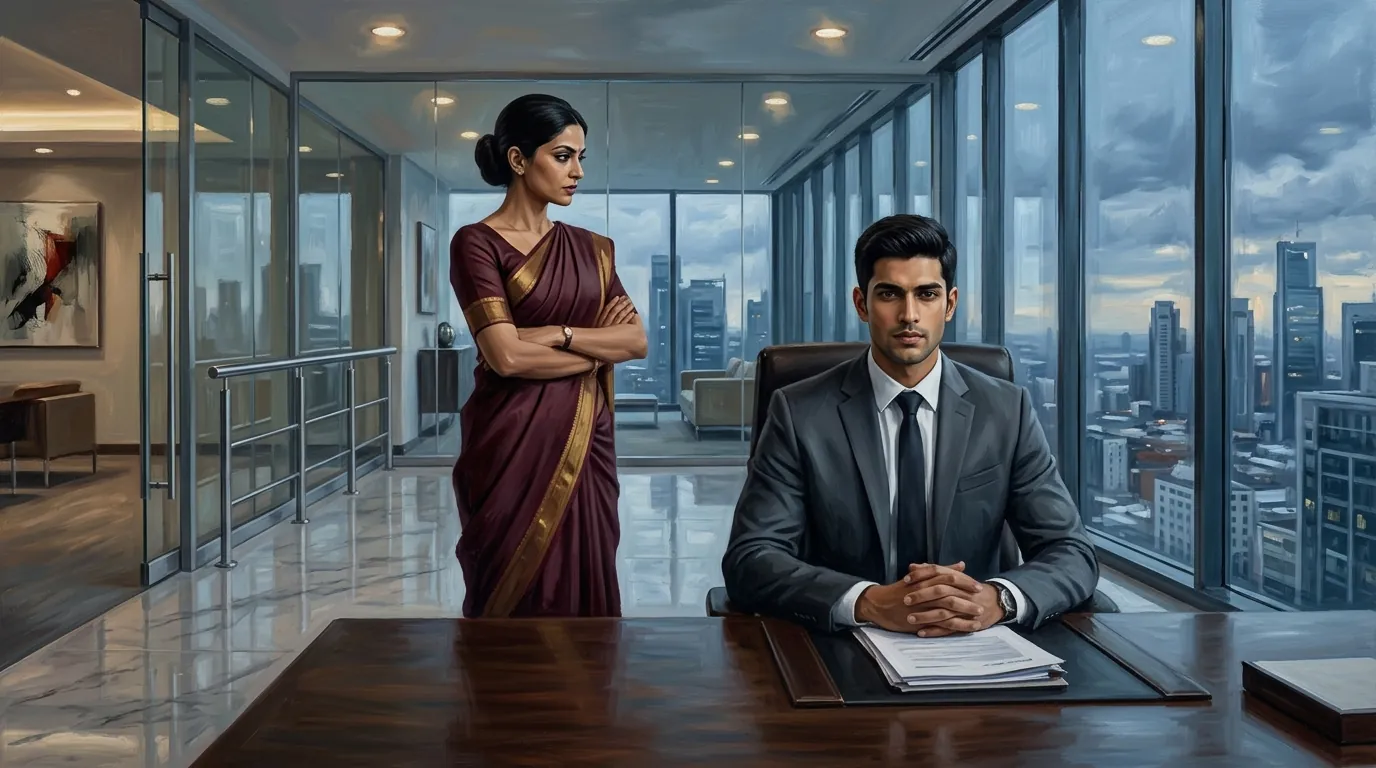
She looks at him for a long moment, and the air between them tightens into something almost intimate—not soft, never soft, but charged, as if both of them are standing too close to a live wire.
Finally, she says, “Your resignation letter. Send it before five.”
He straightens. “As you wish.”
When he reaches the door, her voice stops him.
“Aalekh.”
He turns.
Shalini’s face is unreadable again. “Do not mistake being untouchable for being forgiven.”
His smile is small and unreadable too. “I never do.”
He leaves her office with the sense that he has just been weighed and found dangerous, not innocent. It is the best kind of leaving. Clean. Final. No tears. No pleading. No mistakes.
By two-thirty, the resignation email is drafted.
By three, it sits in his outbox, polished and formal and deliberately brief.
By three-fifteen, the rumors begin to shift shape.
No one in the office speaks too loudly near his desk now. The junior team members who used to hover for jokes and advice pass by with their eyes on the floor. A few pretend they have urgent calls to take. A few have the decency to look curious rather than triumphant. One or two look relieved. That, too, is understandable.
Aalekh does not blame them.
At four, Vasudha Singhania asks for him.
This summons is different.
Not on intercom. Not through an assistant with polished teeth and a controlled voice. A simple message on his phone: Come up.
He goes to the top floor alone.
The founder’s office is warmer than the rest of the building. The light is softer, the furniture deeper, the air touched by old money and older decisions. There are framed covers, award plaques, family photographs in tasteful silver frames, and a silence that belongs only to people who are used to being obeyed.
Vasudha sits near the window in a silk saree the colour of burnt rose, a teacup in her hand and a reading glass chain around her neck. She looks less like a corporate titan than a woman who has survived too many polite betrayals to waste time on surprise. Her face is elegant, her bearing absolute. Even now, after the scandal, she carries herself like the final authority in the room. Maybe because she is.
She gestures to the chair opposite her.
Aalekh sits.
She studies him for a long, unhurried moment, as if he were a product sample she has not yet decided to stock. “You have caused a considerable amount of noise,” she says.
“I’m aware.”
“And you are leaving before I ask you to.”
“Yes.”
Her brows lift slightly. “That is either very smart or very insolent.”
“Probably both.”
A smile enters her eyes and leaves just as quickly. “Most men your age would be begging.”
“I’m not most men.”
“No,” she says. “You are not.”
The tea between them cools untouched. Outside the glass, the city glitters in late-afternoon haze. Inside, Vasudha watches him with the kind of attention that does not flatter and therefore cannot be dismissed.
“You understand,” she says, “that what happens in this company does not remain private simply because the people involved are embarrassed.”
“I do.”
“And yet you are not afraid.”
He considers that. “Afraid and finished are different things.”
That earns him a longer look. Something almost amused, almost impressed.
Vasudha folds her hands. “You are leaving your resignation with your pride intact. Convenient.”
“It’s the only asset I still trust.”
Her lips curve, very slightly. “You think this makes you clever.”
“No, ma’am. I think it makes me difficult to own.”
The words settle in the room like a dropped jewel.
Vasudha’s gaze sharpens, then softens by a degree so small it would be invisible to anyone who did not know how to watch powerful women. She knows, in the marrow of her understanding, what he is doing. He is not asking for mercy. He is not asking for a reference. He is not asking to be saved from the consequences. He is presenting himself as a man who has chosen the shape of his own exit.
That kind of nerve is rare.
It is also attractive in the way a match is attractive to dry grass.
“At twenty-three,” she says, “you have the kind of confidence that usually comes from ignorance.”
Aalekh smiles. “Or preparation.”
She looks at him for a long beat and then gives a quiet, almost reluctant chuckle. “You are very good at making women underestimate the amount of trouble you are capable of.”
“Is that what I’ve done?”
Her eyes rest on his face. “Among other things.”
The room goes still.
For one suspended second, there is something between them—not desire, not exactly, and not trust. More dangerous. Recognition. He has not fooled her. She has not softened him. They both know the game, and they both know he is stepping away before anyone can turn it into a public execution.
Vasudha lifts her teacup and takes a small sip. “I will not have a scene in the building.”
“No scene,” Aalekh says. “I leave quietly.”
“I expect that.”
He rises. “Then I’ll send the final formalities within the hour.”
She nods once. Then, just before he turns away, she says, “Aalekh.”
He stops.
“Do not waste this on bitterness. It suits you less than ambition.”
He faces her again, and this time his expression is open enough to be dangerous.
“Bitterness is for people who wanted to stay.”
For the first time, Vasudha’s face changes. Not much. But enough. Enough to show surprise. Enough to show that she understands exactly how much truth and vanity and hunger sits inside that line.
Then she says, “Go on, then.”
He does.
By five-twelve, the resignation email is in circulation among the necessary people and nowhere else. By five-thirty, the floor has settled into uneasy silence. By six, the crisis management machine has begun doing what it does best: sanding down the edges, rewriting the sequence, calling it “a mutual parting,” “a professional transition,” “an internal realignment.” In Varnika, truth is often less important than the version of it that protects the brand.
Aalekh packs with unnerving calm.
He does not have much to take. A laptop charger. A notebook with half-scribbled campaign ideas. Two pens. A coffee mug someone once gave him as a joke and which he has never bothered to return. A stack of visiting cards. A tie he never wears. A folder of certificates. The small, ordinary debris of a man who has made himself useful while staying impossible to hold.
People do not come to say goodbye all at once.
Nandita appears first, at the edge of his cubicle, after the others have made themselves scarce.
She does not smile. She does not soften. She stands there with her arms folded, watching him tape up the box.
“You’re doing this like it’s a client handover,” she says.
“It is,” he replies.
That almost gets a reaction from her. Almost.
“You should have been smarter,” she says after a moment.
“I was.”
“No,” Nandita says, and her voice is very quiet now. “You were skilled. That is not the same thing.”