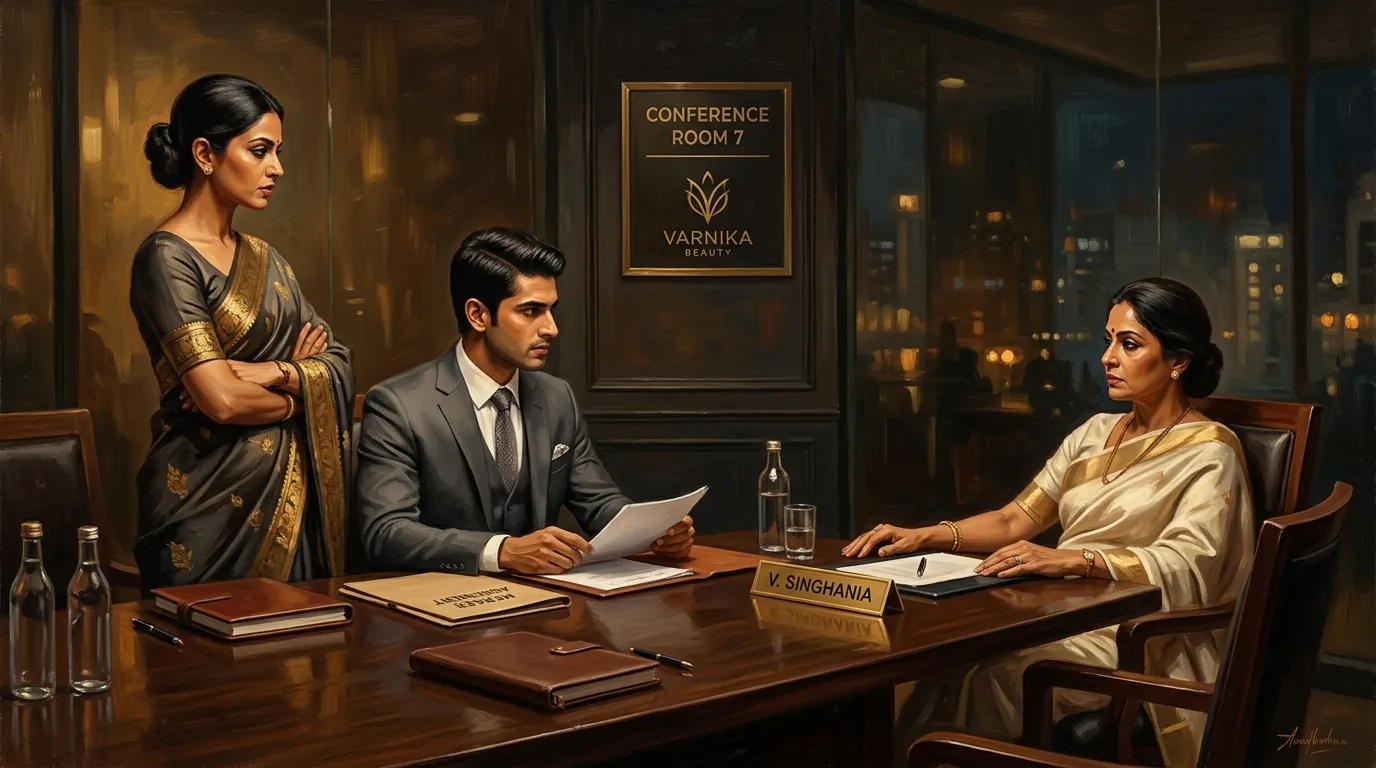
Vasudha finally speaks, her voice softer than Shalini’s and somehow more dangerous for it.
“Did you think we would never compare notes?”
He says nothing.
“Did you think,” she goes on, “that because we run a women-led company we would be too distracted, too sentimental, too proud of our own empathy to notice a pattern? That we would each believe ourselves to be the exception?”
Aalekh’s eyes flicker, almost imperceptibly, at that. Because it is too close to the truth.
Shalini notices. Of course she does.
Her expression hardens.
“There it is,” she says. “You heard the word exception and your face changed.”
He exhales slowly through his nose, then gives a brief, almost apologetic smile. “You’re both overestimating how theatrical this is.”
Vasudha tilts her head. “Are we?”
He leans back a fraction, just enough to reclaim a sliver of posture. “You’ve both built your careers on reading people. You know that every relationship in an organization has politics in it. Mine just happened to be… more visible.”
Shalini’s eyes flash. “More visible?”
“Yes,” he says, and his voice is smooth now, almost gentle. “I made mistakes. I got too personal in some conversations. I was careless with boundaries. But if you’re saying I engineered some elaborate conspiracy—”
“Don’t insult us,” she says.
And there it is again: the steel under silk.
He looks at her, then at Vasudha, and decides that honesty—partial, strategic honesty—may buy him time.
“I did what I thought was necessary,” he says.
Vasudha’s gaze settles on him like weight.
“For what?” she asks.
He holds her eyes. “To move here. To matter. To not be invisible.”
Shalini lets out a short, disbelieving breath. “So you used us.”
He doesn’t answer quickly enough.
That is answer enough.
The room goes still.
Outside, somewhere beyond the frosted glass, the building hums with the late-night life of a company too large to sleep. Elevators. Security radios. The distant murmur of someone laughing near the pantry. Ordinary sounds. Fragile sounds. As if the world is not collapsing in here.
Vasudha studies him for a long moment. Then, unexpectedly, she asks, “Which one of us did you think would save you?”
The question slices the air open.
Aalekh’s mouth parts slightly before he closes it again. For the first time that evening, something like real caution enters his face.
Shalini sees it. Her eyes narrow.
“You did think that,” she says. “You absolutely did.”
He says, very quietly, “I thought you would understand ambition.”
Vasudha’s expression does not change, but the temperature in the room drops.
“Ambition,” she repeats. “Do not confuse predation with ambition.”
He almost smiles at that—almost, because she is not wrong, and because being corrected by Vasudha Singhania carries a strange, humiliating intimacy. He has been scolded by senior women before. Not like this. Never like this, with such complete knowledge of the shape of him.
Shalini straightens and walks around the table until she stands behind his chair. He feels her there before he sees her in the glass reflection—a dark, elegant presence at his shoulder, close enough that he can sense her perfume and the heat of her body through the air, though she does not touch him.
Her voice comes low, near his ear.
“You have been playing a very long game for a boy who still thinks charm is a personality.”
He keeps his gaze ahead.
“Look at me,” she says.
He does.
Shalini’s face is composed, but her eyes are unmistakably furious now. Not loud fury. Controlled fury. The kind that has already decided its next move.
“Tell me,” she says, each word measured, “did you ever mean any of it?”
The question hangs there.
This is the question beneath all questions. Not about policy. Not about HR. Not about the board. Not even about scandal. Women like Shalini do not ask men like him whether they are guilty. They ask whether the lie had warmth in it. Whether the tenderness was counterfeit from the beginning. Whether they were foolish, or merely human.
Aalekh looks past her for a second, toward the glass wall, toward the darkened office beyond. In the reflection, he sees himself with two powerful women flanking him in a room that smells faintly of paper, tea, and expensive restraint.
He should lie. He is very good at lying.
But lying now would be too easy, and easy things are often traps.
So he says, carefully, “It was real enough.”
Shalini’s face goes still.
Vasudha’s eyes sharpen.
Aalekh continues, voice quiet and even. “For the moments they needed to be. For the conversations. For what people wanted to hear. Real isn’t always pure.”
Shalini’s laugh is brief and joyless. “How convenient for you.”
He gives the smallest shrug. “It’s the truth.”
“It is not the truth,” she says. “It is a refuge.”
Vasudha leans forward now, resting her forearms on the table. “Then let us ask the cleaner version. Did you care?”
Aalekh does not answer immediately.
Because this is the one question that can damage him from the inside.
He thinks of Nandita’s controlled silence, of Priya’s tired eyes when she forgot to armor herself, of the way Shalini looked at him once when he solved a crisis and made him feel—absurdly, dangerously—seen, and of Vasudha herself, who never once gave him the luxury of thinking he had fooled her entirely.
He thinks of the way each of them made him feel larger than his own age.
Wanted. Protected. Selected.
He thinks of how quickly desire can become dependence when one person has power and the other has hunger.
Then he says, “I cared about what it gave me.”
Shalini’s expression shifts—not into surprise, but into something colder. Final.
Vasudha sits back, as if he has just confirmed a calculation.
“Better,” she says softly. “At least now we are not pretending.”
Aalekh looks from one woman to the other and understands, with unpleasant clarity, that the room has already moved past the stage where he can charm his way out. There is no easy hand on the shoulder, no indulgent warning, no private protection from one woman against another. The alliance is complete enough to be dangerous.
Shalini reaches for a second folder from the table and flips it open.
“Here is where we are,” she says. “The internal review has begun. HR is aware. Legal has been briefed on enough to recommend suspension pending inquiry. If the board takes this to the media, it becomes a reputational event. If the media gets it first, it becomes a brand crisis. If one of the women you entangled decides to speak publicly, it becomes personal destruction.”
She looks directly at him.
“And if you think I am being dramatic, remember that our investors do not pay us to protect pretty boys with good diction.”
Aalekh’s mouth tightens.
Vasudha adds, almost conversationally, “We can end this quietly. Or we can let it become the kind of cautionary story that follows a man for the rest of his career.”
He sits very still.