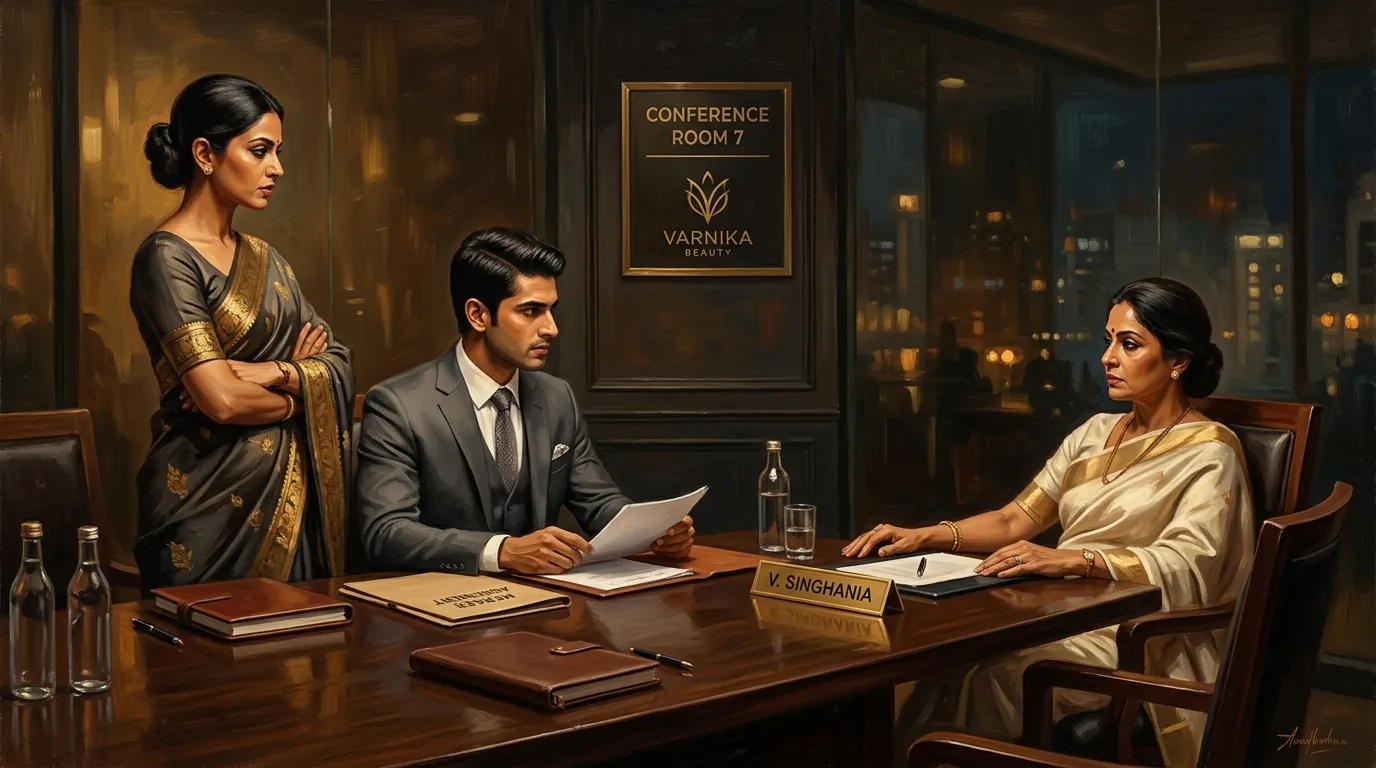
Quietly. That word lands with almost obscene power. Quietly means extracted, managed, erased without spectacle. Quietly means mercy, but only of a corporate kind. No headlines. No public humiliation. Just a sealed file, a damaged reputation, and the long private consequence of being known.
“Why are you telling me this?” he asks.
Shalini’s eyes are hard. “Because I want you to understand the difference between being protected and being tolerated.”
The words strike deeper than they should.
Aalekh looks at her, and for a moment his expression loses its polish. Only for a moment. Enough for a crack, not enough for surrender.
Vasudha watches that crack with the interest of a woman who has seen empires rise and men collapse over less.
Then she says, “You have one chance to speak plainly. Was anyone here ever more than a rung on a ladder?”
The question is brutal in its simplicity.
Aalekh’s throat moves once.
He could say no. It would be believable enough, perhaps. He could say yes. It would be worse. He could say something artful and leave everyone angry. But the room has already taken his measure. There is no answer that restores him.
So he chooses the only answer that preserves a sliver of control.
“Different things were real to different people.”
Shalini stares at him for a long beat.
Then, in a voice so calm it is almost intimate, she says, “Get out.”
He does not move.
Vasudha says, without raising her voice, “Aalekh.”
It is not a command. It is more dangerous than a command. It is disappointment wearing silk.
He stands.
The chair slides back with a soft scrape that seems far too loud in the room. He keeps his face composed, but something inside him has shifted—an internal alignment, a recognition that the board he has been standing on is no longer steady.
Shalini doesn’t step aside as he comes around the table. He has to pass within arm’s length of her. Close enough to feel the edge of her perfume. Close enough to notice the pulse in her throat, quick and controlled, the smallest sign that she is still very much alive with anger.
He stops for the briefest instant.
“Shalini,” he says, not pleading, not yet.
She looks at him as if he is already a past tense problem.
He tries Vasudha’s name next, softer, almost respectful.
She holds his gaze and says, “You should have been more careful.”
Not kinder. Not crueler. Just true.
He nods once, because anything else would be performance, and perhaps for the first time in this building, performance is useless.
He reaches the door.
Behind him, Shalini says, “One more thing.”
He turns.
She stands with one hand on the back of the chair, the other resting lightly on the file. Her face is composed again, but the anger remains in the eyes, banked and bright.
“If you think this ends with us,” she says, “you are still underestimating women.”
Aalekh almost smiles at that. Almost.
Instead he inclines his head. “I never made that mistake.”
Vasudha’s laugh this time is faint, almost approving, and somehow that is the worst sound in the room.
He leaves before they can say anything else.
The corridor outside is too bright after the conference room’s controlled darkness. He stands there for a second, hand on the door handle, listening to the silence behind it as if it might still be speaking. It isn’t. The women inside are not discussing him anymore. They are deciding.
That is what women like Shalini and Vasudha do when the performance is over.
They decide.
Aalekh walks to the lift with measured steps, face smooth, shoulders relaxed, as though his body has not just been cut free from the structure that held it. The building reflects him in passing: a young man in a white shirt moving through a palace of glass and consequence, still handsome, still composed, still too calm for anyone who does not know how much calculation is hiding beneath the calm.
His phone vibrates in his pocket before the lift arrives.
A single new email notification.
From HR.
He doesn’t open it in the corridor.
Not yet.
He looks at the black mirror of the lift doors and sees his own reflection waiting back at him, eyes unreadable, mouth almost amused. Whatever happens next, he has time to choose the shape of his exit. Time to protect what can be protected. Time to decide which truth will be useful and which will be buried.
The lift chimes softly.
The doors begin to part.
And as the polished metal opens to his reflection and the darkened depth beyond, Aalekh’s phone lights up again in his hand—this time with a name that makes his mouth curve, just slightly, before he steps inside.