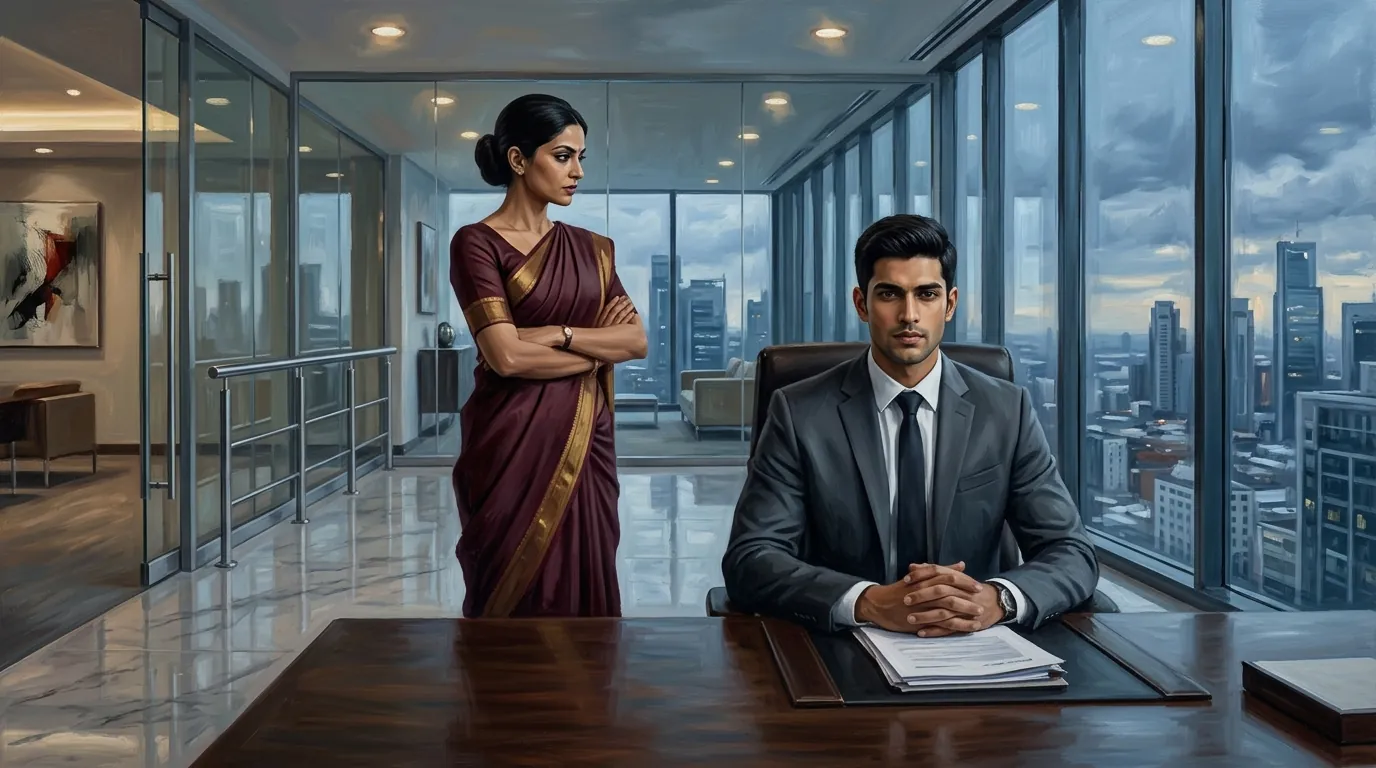
By Monday morning, Varnika Beauty looks immaculate in the way a woman looks immaculate after crying in a locked washroom: the lipstick is fixed, the collar is straight, the smile is back in place, and only the eyes know what happened.
The glass façade catches the winter light and throws it back like a challenge. Inside, marble floors, chrome railings, pale orchids in square planters—everything gleams with the controlled confidence of a company that sells glow for a living. But the air is different today. Quieter. Tighter. Even the reception desk seems to have lowered its voice.
News travels faster than policy at Varnika.
By nine-thirty, everyone knows there was a meeting on the twelfth floor yesterday evening. By ten, everyone knows it was not about launch numbers. By ten-fifteen, everyone knows Aalekh Srivastav was in that room long enough to change the temperature of it. By eleven, the story has been polished into office folklore: raised voices, a closed door, someone leaving with her face unreadable, someone else with her jaw set so hard it could crack glass.
No one knows the exact words.
That is what makes it worse.
Aalekh knows, of course. He sits at his desk on the seventh floor with his sleeves rolled to the forearm, one hand resting loosely on a file that no longer interests him, the other scrolling through messages he does not intend to answer yet. He looks composed enough to fool an outsider. Inside, everything is awake.
He has always liked the moment after the storm. The air still carries electricity. People avoid eye contact. Every sound lands heavier than it should. It is the perfect time to notice who flinches, who watches, who is pretending not to.
Nandita passes his workstation at ten-twelve, a stack of presentation printouts against her chest. She does not stop. She does not even slow down. But her eyes flick to him once—sharp, assessing, almost clinical—and in that glance there is no heat, no softness, no invitation. Only recognition.
He meets it with a neutral expression.
Nandita’s mouth tightens by a fraction, not in disapproval exactly. More like she has reached the end of an equation and found the answer unpleasant but not surprising.
She stops beside his chair for one beat too long.
“Your draft for the campaign calendar,” she says quietly, voice level, “send the revised version before lunch. No drama.”
Aalekh looks up at her. “Of course.”
Her gaze holds his for a second longer. There is something almost severe in the way she studies him now, as if she is making a private note of how a man looks when the room around him finally stops pretending.
Then she turns and walks away, the line of her back straight and unbending.
No rescue. No scolding. No warmth.
But respect, he thinks, is its own kind of touch.
Priya appears next.
She does not come to his desk. She never would, not in front of the floor. Instead, she pauses near the central printer, pretending to check a sheet while her eyes move once, swiftly, over him. Her saree is pale today, the kind of ivory that makes her look more tired than elegant, more human than managerial. Her bangles catch the light when she adjusts the papers in her hand.
She looks at him and there is no accusation in her face.
Only fatigue.
Only relief, carefully hidden.
Their eyes meet for a brief moment, and he sees it—the faint loosening at the corners of her mouth, the almost imperceptible exhale. Not because she is heartless. Because she is done carrying something she never should have had to carry in the first place.
He gives her a small, respectful nod. She returns it.
Nothing is said. Everything is understood.
She walks off with her files and her burden and whatever loneliness had once made her dangerous to herself.
At noon, Shalini Rao summons him.
Her assistant’s voice on the intercom is cool enough to freeze a room. “Mr. Srivastav, ma’am wants to see you. Now.”
Aalekh rises without rushing. He smooths the front of his shirt, checks his cuff, and walks to the CEO’s office with the measured calm of a man going to collect either promotion or punishment. In Varnika, those two things often arrive wearing the same perfume.
Shalini stands at the far end of her office, backlit by the city beyond the floor-to-ceiling glass. She does not offer him a seat. She rarely offers comfort of any kind. Her hair is pinned flawlessly, her saree severe and expensive, her expression carved from the kind of restraint that has made lesser men feel naked.
The door closes behind him with a soft click.
For a moment she says nothing. The silence stretches, deliberate and exacting. She lets him feel it. She knows the power of making a man wait inside his own skin.
Then, at last: “You are late.”
He glances at the clock on the wall. “By thirty seconds?”
“By much more than that.” Her eyes do not leave his face. “You should have come yesterday.”
He leans lightly against the edge of the table—not too casually, not too familiarly. Just enough to suggest ease. “I wanted to give everyone time to breathe.”
A faint, cold amusement touches her mouth. “How considerate of you.”
The words are dry enough to cut. He does not react.
Shalini takes one step closer. In heels, she moves like a blade being drawn.
“You are very good at standing in rooms and making people believe they have misunderstood you,” she says. “That is a skill. Not a virtue.”
“No,” he agrees. “But useful.”
Her gaze sharpens. It is the look of a woman who has spent years across boardrooms from men who mistake her precision for mercy. “Do not try that tone with me.”
He inclines his head. “I wouldn’t dare.”
A beat.
Then she says, with surgical calm, “We had a crisis. You made it worse. And now you have the nerve to look like the only dignified person in the building.”
Aalekh lets a small smile appear and then fade. “I’m trying not to embarrass anyone further.”
“By leaving?”
“Yes.”
That gets her attention.
Shalini studies him in silence, and the silence is not empty. It is full of judgment, calculation, and an unwelcome flicker of understanding. She knows what he is doing. She knows he is not here to beg. She knows he has already decided on his exit and simply came to make sure the room could not trap him in it.
“You think this is brave,” she says.
“No.” His voice remains even. “I think it is efficient.”
Something like approval passes through her eyes, brief and dangerous. It is the closest thing to affection she ever allows.
“And if I tell HR to proceed?” she asks.
He smiles then, very faintly. “Then you’ll have to explain why the company’s most productive embarrassment was allowed to remain in the building this long.”